OUR JOURNEY
L.I.N.K. (Linking Indigenous & Non-Indigenous Knowledge), a local Cape Cod organization, was formed in 2022 by a group of non-Indigenous folk living on Cape Cod. We felt a lack of connection between ourselves and the Wampanoag people and werelooking for ways we might effect change. It became clear to us that before there could be any possibility of change, we needed to educate ourselves as to the true history and culture of the Wampanoag people.
We started by creating a study group and then a community book group. We obtained 501c3 status, raised funds, and brought education to the larger community through programs taught by Indigenous teachers and elders. We saw the value of an Indigenous world view including a deep connection to the earth (see list comparing Western and Indigenous world views view here). We learned the horrific history of genocide, the taking of the land, and the injustice of broken treaties. We came to understand that we ourselves were living on land stolen from the Wampanoag people.
While our programs contributed to raising awareness within our community, we view them as only a beginning. In late 2025, the L.I.N.K. Core Group (now 10 of us) took a pause in our programming. We began a time of reflection, a rethinking of the role of L.I.N.K. as an organization, and how we at L.I.N.K. might be of service going forward.
Our journey with L.I.N.K. has been personal. We as individuals are not where we were when we started in 2022. We have learned so much, surprised by what we didn’t know. We recognize that we are in an ongoing, cyclical process which could be described as follows: It often begins in our heads, with an intellectual learning of facts, such as the many tactics used to commit genocide and take land. As it breaks through layers of ignorance, denial and hidden bias, this information impacts us emotionally, allowing shock, anger, grief and empathy to surface. Hearts break open, and we will never see or feel the same again.
This is the process of our own internal decolonization. As we open ourselves further to better understand the ways of being that our Indigenous knowledge-keepers have introduced to us, we have begun to deepen our own relationships with the natural world. We are learning to integrate and ground our growing awareness and understanding in our own bodies. We realize that this process can't be forced. It must be nurtured, allowed to uniquely unfold in each of us, and it requires a safe and accepting community in which to occur.
In seeking to “decolonize”, we recognize the continued influence of settler colonialism. Rather than holding guilt for the past, we are choosing to take responsibility for the present.
Our goal is to join with others as we bring to L.I.N.K.’s wider community the understandings we are coming to – through our website and list of resources, our Community Book Group, conversation circles, films, speakers, and other offerings. We also recognize and value the many other ways in which Wampanoag wisdom and knowledge is being offered and shared by other people and organizations.
Everything that is important about the possibility of Wampanoag and non-Indigenous relations rests on a shift in our individual and collective consciousness. This is our vision.
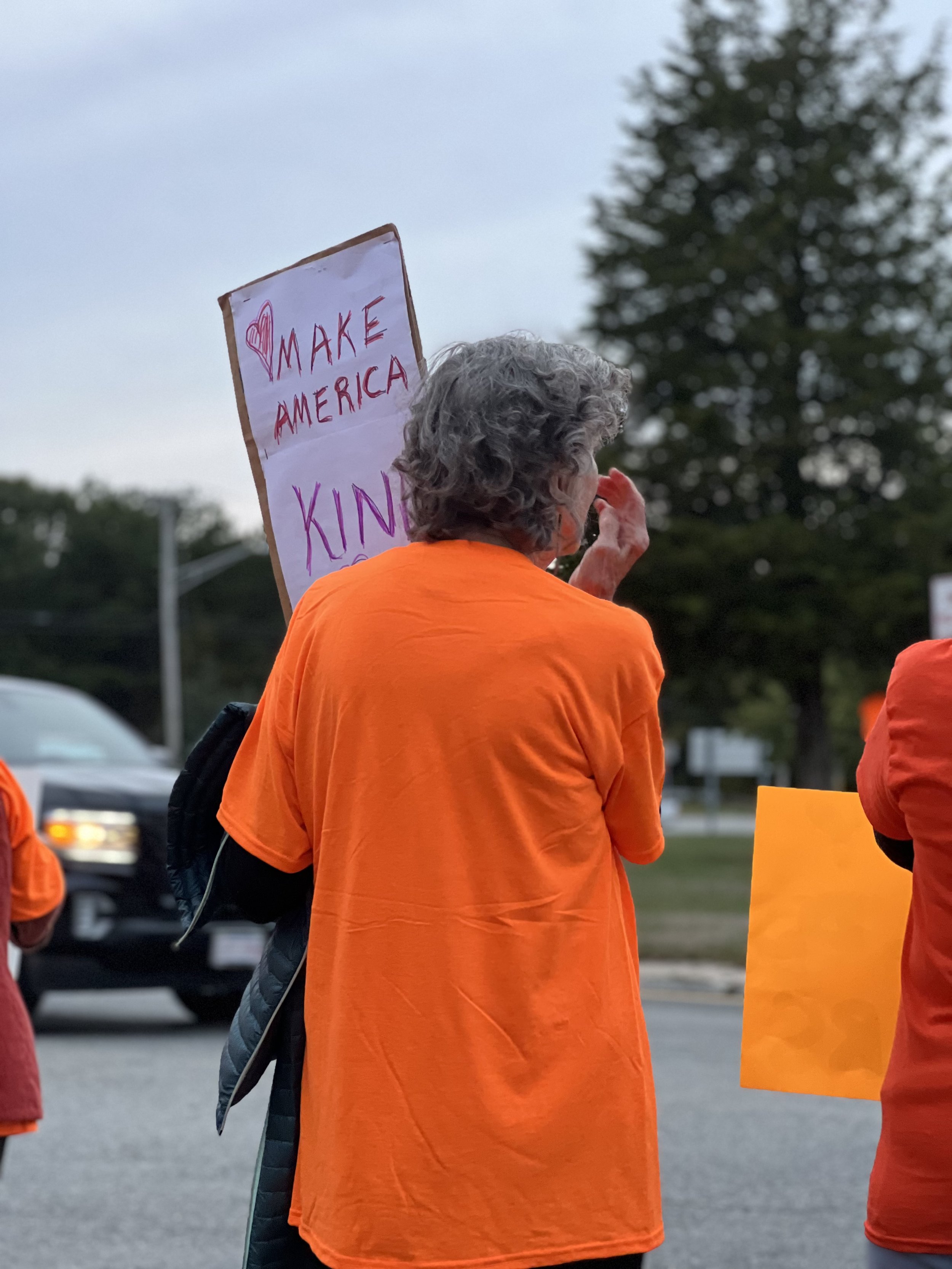
L.I.N.K. at Orange Shirt Day --
Every Child Matters

Reflections on what led participants to join
Click the downward arrow to read our stories.
-
My journey to L.I.N.K. began with the transformative teaching I received on the Hopi Reservation many years ago: “Everything in everyday life is sacred”. In the winter of 1999, I found myself planted in a small cape house on the bank of the Moonakis (Quashnet) river in a part of Falmouth that was once Mashpee. It’s hard to fully communicate my connection to this place: I feel quiet and peaceful, joyful and expansive. I feel a sense of belonging to the trees, the sky and the water, the wind and the softness of the air, and to the osprey, hummingbirds and swans with whom I share this space. Daily, I'm filled with gratitude and awe. More recently, I was part of a restorative justice group in Falmouth. While we studied the genocide of Native Americans, beginning with the truth about our stealing and occupying the land, I started to feel the complexity of my current situation: I didn’t steal the land, yet now that I know how horrific this genocide was and is still going on and my own privilege living here, what’s mine to do? Questions about the land became even more personal and unsettling when I spoke with both the white descendants and a Wampanoag woman whose families had past connections with the place I call home. Aware that we live practically next door to the Wampanoag People and have this long, painful and ongoing relationship of oppressor and oppressed, I asked myself: What are the possibilities for growing respect and trust? What could lead to healing and honest working together to create local systemic change? Paula Pace, a restorative justice friend, and I decided to attend a training called Dialogues across the Divide. Inspired, we came home to Falmouth and L.I.N.K. was born.
— Marilyn
-
Why I started LINK
At 80 years old, I’m ready for change. Most of my life I’ve worked towards social justice. I am deeply distressed by the damage/violation people of my race have done to our earth and the cruelty inflicted on Native peoples that amounts to cultural and physical genocide. I am in awe of what I know of Native peoples' profound connection to the land, respect for all life forms, and the centuries of their stewardship.
I feel such a loss — while the Wampanoag Nation is right next door, until recently I and most of my community have had little or no relationship with the Wampanoag people. When I learned I was living on stolen land, I literally could not stop thinking about it. How do I as a moral person contend with that fact?
I started L.I.N.K. with my friend and colleague, Marilyn Hajer, to bring these issues to our community: to own and acknowledge the past and the biases that originate from a white supremacy culture; to take action to reckon with that past and honor the contributions of Native people; to find ways to stand with the Wampanoag people, in partnership, taking cues from them, searching how healing can happen.
Understandably, trust, after hundreds of years of mistreatment and deception, is a long-term process. I believe it essential that our organization, L.I.N.K., be based on consensus and that it reflect the values of respect, integrity, and kindness; that we who seek to be trusted truly walk our talk.
— Paula
-
I found L.I.N.K. as a result of joining a book club, which focused their readings on anti-racist books. Here, I started to awaken to the atrocities inflicted upon non-white people, and especially the genocide of the Native American people.
As a part of the L.I.N.K. (Linking Indigenous and Non-Indigenous Knowledge) group, I have been taking a closer look at my own racial and cultural biases. I want to take responsibility for my actions, or lack of. Today, I am now ready to take a more active role in my community in standing up for - and with - my Native American family. My hope is to recognize and dismantle systems that keep people like me complicit in the atrocities inflicted on the true Native People of America. I too, as other members of this group, want to be an agent for change.
— Rachael
-
In the early years of my education, colonization of the United States was portrayed in only one light; the white man’s right to take the land from indigenous people.
Over the years, I visited many places in the southwest learning about indigenous tribes, their culture, and traditions. Then moving to Cape Cod, I have the privilege of knowing and learning about the Wampanoag people, their culture and experiencing their traditions.
The true story of colonization began emerging for me by attending a course in Indigenous Peoples Conference, and viewing the documentary, Dawnland, presented by the Upstander Project.
L.I.N.K. has become a vehicle for me to address and acknowledge the harm and trauma that has been committed against Native Americans. Through education, reflection, and dialogue with Native teachers, we can begin to heal and become allies to our Wampanoag neighbors.
-
As a white person living on Cape Cod for over 50 years, I am still amazed at my lack of knowledge when it comes to the suffering and hardship, the genocide inflicted on my Wampanoag neighbors, whose people have managed to persist here for thousands of years.
“How could I not have known? Or did I? How could these things have been done? They are still going on! How have they endured?”
Like many other white people I have slowly become aware that, in wanting to be part of the solution to the injustices I see happening in the world, I first have to recognize that, as an inheritor of settler colonialism, I am part of the problem and that I have some deep, personal work to do. What parts of a dominator legacy do I still carry? Where am I still blind? Although I began the process a while ago, LINK offers the opportunity to continue it with others within my own local community. Our focus here is specifically on the history, culture, and current challenges of the Wampanoag people, on whose unceded land we now live. We are here to acknowledge and raise awareness of both their trauma and their resiliency, the transgressions of our own European ancestors, and the wisdom of Indigenous values and culture. I’m grateful for the guidance of our Wampanoag advisors and for the willingness of other members of the Tribe to meet and receive us. My hope is that we may find a way to make amends, to take action on their behalf, to become good neighbors and perhaps even friends some day.
— Laura
-
Having studied Native American history and culture and having worked with Mashpee Wampanoag families, I’ve been searching for a way to be a true ally to the Mashpee Wampanoag People. L.I.N.K. has given me that opportunity to delve deeper into indIgenous knowledge and, when we are ready, to respectfully take action to support the Tribe in whatever way we're needed. I am so grateful to do the work together with the other members of L.I.N.K.
—Lois
-
Fearful of the harm we cause, I seek healing.
Worried for the damaged Earth, I turn to the teachings of nature.
Wanting greater respect for the land, I open my mind to a different wisdom.
Aware of the things I never learned, I lean in with curiosity.
Believing that we can be better, I breathe deeply.
Hoping to find a path forward, I listen.
--Cathy
-
I have been a music maker my whole life. Music has been the way I encounter the world and the people around me. Slowly, over the course of several decades, it has led me to ask deeper questions about our collective history and our responsibilities as individuals and communities. These questions have no simple answer and take enormous persistence and patience to unpack. I am grateful to be a part of L.I.N.K., where we can question, share and learn together.
— Carla
-
I’ve always known right from wrong. I’d read the newspaper, turn to my wife, and say, “Listen to this...,” then I’d read her the transgression(s) of the day, shake my head, and turn the page. When George Floyd was killed in May of 2020, I couldn’t just turn the page. I had to address the problem. I wanted to be part of the solution. I wanted to eradicate racism. I started writing letters to the editor. I joined the Mashpee Inclusion and Diversity Committee. I also came to an embarrassing realization: I lived in Mashpee, “Land of the Wampanoag” but I didn’t know any Wampanoag people and I knew little about them. Slavery is often called America’s original sin. What about what we did to Indigenous Peoples? I joined LINK to learn about Wampanoag history and culture, to face unpopular truths, and to become a better ally.
— Dan